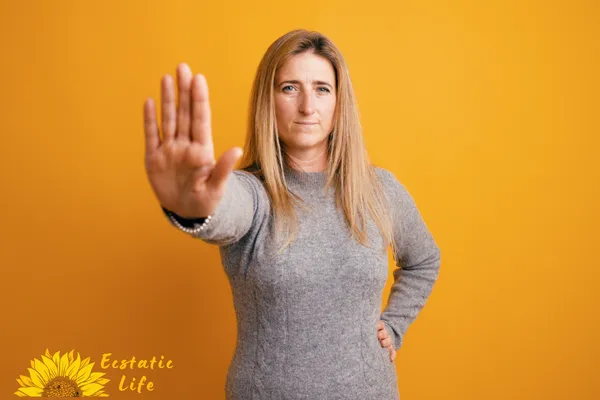
Boundaries Are Not Walls: How to Say Yes and No From Your Whole Self
What if a boundary isn't about keeping people out?
What if it's simply a way of telling the truth about where you end and someone else begins?
We often think of boundaries as saying no, being firm, protecting ourselves, or keeping people from crossing a line.
But healthy boundaries aren't about becoming harder.
They're about becoming clearer.
Clearer with yourself.
Clearer about your needs.
Clearer about your yeses and your nos.
And clearer with the people around you so they actually know what you are and aren't available for.
You can have strong boundaries and still be warm, loving, caring, accepting, open-hearted, and available for intimacy.
You don't have to become an ice-cold bitch to have boundaries.
A strong boundary doesn't necessarily have to be a “you can't.”
It can simply be:
“This is what I am available for, and this is what I am not available for.”
Boundaries create authentic relationship
Boundaries aren't just about protecting yourself.
They're about honoring the relationship.
Without boundaries, I can't actually tell you the truth about what I want, what I desire, what I'm available for, and what I'm not available for.
And if I'm not telling you the truth, you're not actually in relationship with me.
You're in relationship with a version of me that I'm performing to please you.
Eventually, that becomes resentment.
Withdrawal.
Passive aggression.
Criticism.
Disconnection.
We can't authentically connect when we're constantly abandoning ourselves.
My boundaries actually give you accurate information about who I am.
A boundary isn't a wall
There's an important difference between a boundary and a wall.
A wall says:
“I don't trust you. Stay away from me.”
A boundary says:
“I'm not available for that.”
A boundary can be soft in tone and firm in content.
You don't have to be angry.
You don't have to make someone wrong.
You don't have to explain yourself over and over.
You don't have to punish someone.
You can simply be clear.
Here is where I am.
Here is what I'm available for.
Here is what I'm not available for.
And a boundary doesn't have to be a door slammed in someone's face.
But that also doesn't mean you have to hand someone the keys to your front door and let them come in whenever they want.
What is a genuine yes?
Boundaries aren't only about saying no.
They're also about knowing your yes.
This can be especially difficult if you're someone who has spent years people-pleasing.
You may ask yourself:
Do I actually want this?
But underneath that question can be a whole pile of other questions:
Should I?
Are they going to be disappointed?
Am I going to hurt someone's feelings?
Will I look selfish?
Will saying no make me a bad person?
So instead ask:
Is there a genuine yes in me?
And this is where embodiment becomes so important.
A genuine yes isn't only something you think.
It's something you can feel.
Maybe there's an opening.
Spaciousness.
Warmth.
Tingling.
Curiosity.
Excitement.
Energy.
Maybe even a little turn-on.
Your body has information.
Especially if you've spent years overriding yourself, learning to recognize that information can take practice.
So don't answer automatically.
Pause.
Feel.
And sometimes the answer isn't yes or no.
Sometimes it's:
I need more time to sit with this.
And that is a boundary, too.
How to communicate a loving boundary
Once you've identified your truth, how do you actually communicate it?
I like a simple three-part framework.
1. Name the truth.
“I don't enjoy conversations where we talk behind other people's backs.”
2. State the boundary.
“I'm not available for that type of conversation.”
3. State what you ARE available for, if appropriate.
“I'd be happy to talk about what's actually happening in your life.”
No to this.
Yes to this.
And I'm still here.
That's the energy.
You can use this same framework with someone from your past:
“I'm glad we were able to reconnect at that family gathering and that some of the tension has been smoothed over. I'm not available right now for opening up into a deeper relationship, but I'd be happy to see you at family gatherings in the future.”
That's not a total shutdown.
It's simply telling the truth about the level of relationship you're available for.
Remember: You are not responsible for their response
This is especially important if you're a people-pleaser.
You can be clear.
Respectful.
Loving.
Kind.
Compassionate.
And someone may still be disappointed.
They may even be angry.
But you're not responsible for their emotional reaction.
Someone being upset by your boundary doesn't mean your boundary was wrong.
And the reverse is true.
When someone else tells us no, we need to respect that.
We don't need to convince them.
We don't need to interrogate them.
We don't need to argue.
We don't need to demand an explanation.
We can care for ourselves, regulate our own emotions, and respect their sovereignty.
Because ultimately, that's what this is about.
Sovereignty.
